

Benjamin Ryzman
24 posts

Why moving from pilots to production changes the platform Artificial intelligence has moved beyond the demonstration phase. Telco operators are already exploring it for fault diagnosis, energy management, capacity planning, customer care, and radio access network (RAN) optimization. Enterprise customers, meanwhile, are asking for private
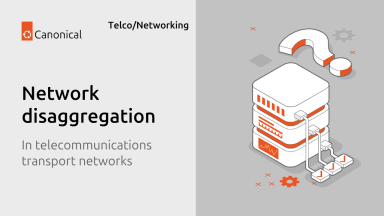
Telecommunications networks have traditionally been built from tightly integrated systems. A router vendor supplies the forwarding hardware, network operating system (NOS), routing protocols, management interfaces, upgrade process, and support contract as one product. However, growing demands for flexibility and cost control have prompted
Previous articles walked through RDMA (Remote Direct Memory Access) as a programming model and InfiniBand as the fabric that was built around it. Both led to the same conclusion, even if it was never stated outright: moving data, not compute, becomes the bottleneck once systems scale. So what happens when you want RDMA, but you’re

When distributed workloads stall because nodes cannot exchange small messages quickly and consistently, the network is the limiting factor. How do you solve that problem? InfiniBand offers one solution. InfiniBand is an interconnect, meaning the end-to-end communication system that links compute, storage, and accelerator nodes. It is impl
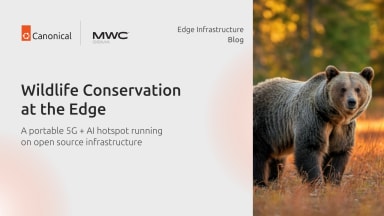
From March 2-5 in Barcelona, Canonical will present a working wildlife conservation platform that combines open source 5G, AI, and cloud-native infrastructure in a travel friendly form factor. At the center is a portable 5G AI hotspot built on Ubuntu and Canonical Kubernetes, running on Arm-based Ampere servers. It connects drones, trail

coRAN Labs and Canonical at MWC Barcelona 2026 At MWC Barcelona 2026, coRAN Labs and Canonical are presenting a working demonstration of a cloud-native, quantum-safe telecom platform for 5G and beyond 5G networks. This is not a conceptual exercise. It is a full 5G System (5GS) deployment with post-quantum cryptography embedded across the
Building telco clouds with open source At MWC Barcelona 2026, Canonical is demonstrating how telecommunications operators and enterprises can design and operate a cloud on their own terms: sovereign, cost-effective, and built on open platforms that span from core data centers to the intelligent edge. One of the demos is the result of Cano
Modern data centres are hitting a wall that faster CPUs alone cannot fix. As workloads scale out and latency budgets shrink, the impact of moving data between servers is starting to become the most significant factor in overall performance. Remote Direct Memory Access, or RDMA, is one of the technologies reshaping how that data moves,
Telecommunications networks are undergoing a cloud-native revolution. 5G promises ultra-fast connectivity and real-time services, but achieving those benefits requires an infrastructure that is agile, low-latency, and highly reliable. Kubernetes has emerged as a cornerstone for telecom operators to meet 5G demands. In 2025, Canonical Kube
5G continues to transform the telecommunications landscape, enabling massive device density, edge computing, and new enterprise use cases. However, operators still face significant cost pressures: from accelerating RAN modernization and 5G SA rollouts to energy demands and the shift to cloud-native network functions (CNFs). As telcos rede
Sylva 1.5 becomes the first release to include Kubernetes 1.32, bringing the latest open source cloud-native capabilities to the European telecommunications industry. With the launch of Sylva 1.5, Canonical Kubernetes is now officially part of the project’s reference architecture. This follows its earlier availability as a technology prev
Organizations everywhere are pushing AI and networks closer to the edge. With that expansion comes a challenge: how do you ensure reliable performance, efficiency, and security outside of the data center? Worker safety, healthcare automation, and the success of mobile private networks depend on a robust technology stack that can withstand
At NVIDIA GTC Washington D.C., Canonical is pleased to support the arrival of the NVIDIA BlueField-4 – the newest generation of the data processing unit (DPU) family. NVIDIA BlueField-4 is an accelerated infrastructure platform for gigascale AI factories. By combining NVIDIA Grace CPU and NVIDIA ConnectX-9 networking, it delivers 6x the c
The telecommunications industry is undergoing its most significant transformation in decades. The move from vertically integrated, proprietary systems to disaggregated, cloud-native infrastructure has unlocked enormous potential for agility and innovation. Yet, for many operators, the challenge has been how to realize that potential while
Reference architectures speed up time to market for agentic AI projects To ease the path of enterprise AI adoption and accelerate the conversion of AI insights into business value, NVIDIA recently published the NVIDIA Enterprise AI Factory validated design, an ecosystem of solutions that integrates seamlessly with enterprise systems, data
The combined solutions simplify infrastructure operations and accelerate time-to-value for AI, telecom, and enterprise computing workloads. Accelerate deployment and operations of BlueField DPUs with Canonical Kubernetes At GTC Paris today, Canonical announced support for the NVIDIA DOCA Platform Framework (DPF) with Canonical Kubernetes